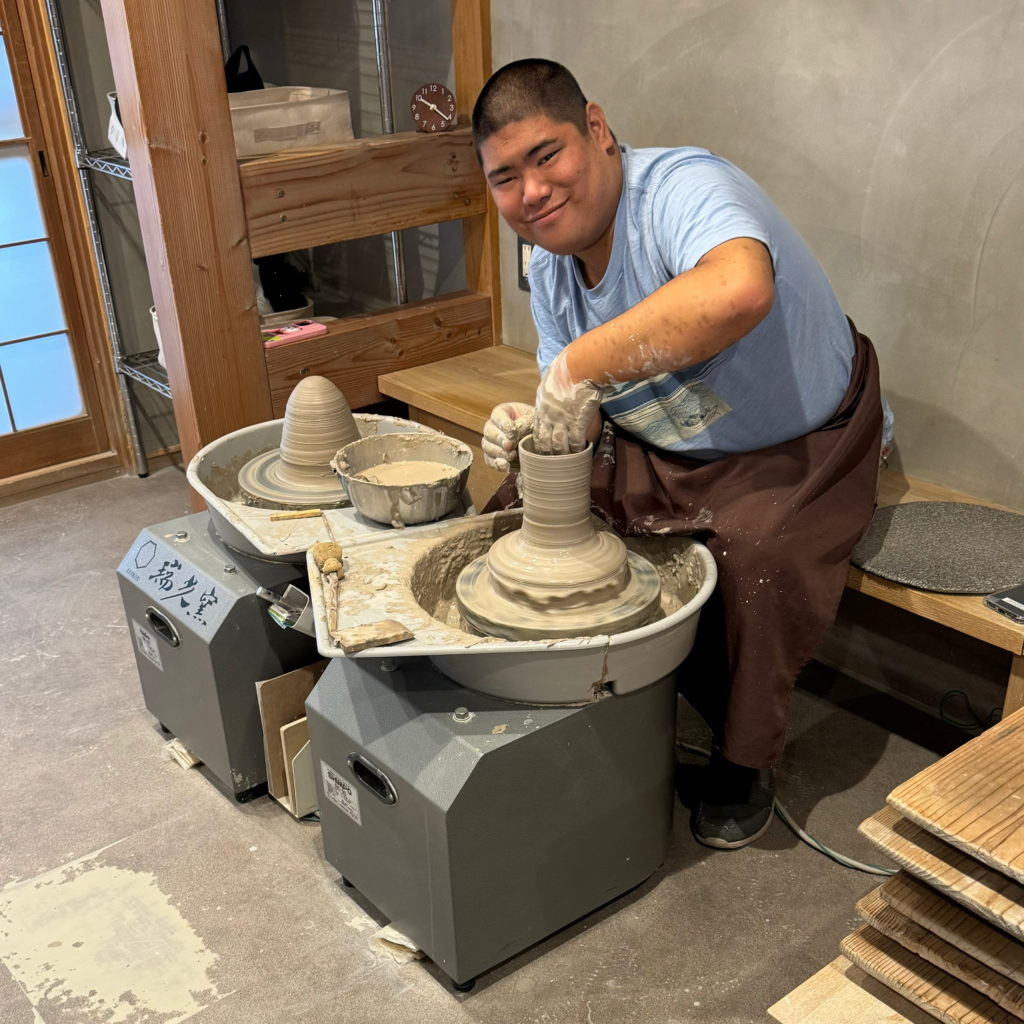
A place to belong
Ceramics didn’t just give me a creative outlet. It gave me a place to belong.
Most people move through the world without thinking much about it. I never had that option. Growing up, I existed in a space between — not blind, but not fully sighted either. Not quite belonging to one world or the other. School wasn’t built for me. Most spaces weren’t. And for a long time, I didn’t have a name for where I stood.
Then I found clay. Ceramics doesn’t ask you to see. It asks you to feel — the thickness of the wall, the give of the clay, the moment a form finds its shape under your hands. The wheel doesn’t care what you can or can’t see. It responds to touch, to pressure, to feel. For the first time, I wasn’t working around a limitation. I was working from a strength. The in-between was exactly where I needed to be.
That in-between space — not fully in one world or the other — is where Between Two Worlds Ceramics was born. It’s what every piece is built from.
The wheel doesn’t care what you can or can’t see. It responds to touch, to pressure, to feel.
How I work
That realization never left me. It’s in everything I make. I work from a home studio in the San Francisco Bay Area, and my practice is built around functional, repetitious forms — dinnerware, vessels, and everyday objects made to be used. I work in multiples, which means each piece is informed by the one before it. Forms evolve slowly, refined through repetition, use, and the kind of attention that only comes from making the same thing over and over until it’s exactly right.
Each session at the wheel, through slab building, or with molding is an opportunity to refine form while keeping the presence of the handmade alive. I work across multiple techniques — wheel-thrown, slab-built, and molded — often combining them within a single piece. Nerikomi and slipcasting are central to my practice — techniques that reward patience and precision, and that let me work with color and form in ways throwing alone can’t. The result is work that is visually intentional and built for daily life, where balance, proportion, and surface are considered alongside function.
Why functional ware
Color and surface are how I communicate my visual point of view. Texture, contrast, and repetition become tools for engagement — inviting touch and use, and emphasizing durability and accessibility in the objects that fill everyday life. I’m drawn to functional ware because it closes the gap between art and life. A bowl doesn’t sit behind glass. It gets used, washed, picked up again. Think about the mug you reach for every morning — the one you fill with coffee or tea before the day begins, the one that just feels right in your hand. The way the rim is smooth against your lips when you take that first sip. That ongoing relationship between object and person is what makes it meaningful to me. I want the work to reward handling, not just looking.
Teaching and sharing
I also teach — because ceramics gave me something that school couldn’t, and I believe it can do the same for others. My focus is on the making — wheel throwing, handbuilding, slipcasting, and surface decoration. The same techniques I’ve spent over a decade developing, shared with anyone ready to get their hands dirty.
Between Two Worlds Ceramics. Made by hand. Built from experience. Grounded in feel.
Hold the work in your own hands
Shop my work. Take a workshop. Explore the glaze resources. Whatever brings you here, you’re welcome.
The best way to understand the work is to live with it. Browse what’s on the shelf, see the full portfolio — or join the email list just below for first access to new pieces.