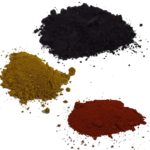
Glaze chemistry is written in the language of oxides. Every material you weigh out — feldspar, whiting, silica, zinc oxide — is a source of one or more oxides that do specific jobs in the glaze. Learning to recognize the chemical formulas of those oxides, and understanding what role each one plays, is the foundation of reading and writing glaze recipes with intention rather than guesswork.
The Three Oxide Groups
Glazes are built from three categories of oxides, each performing a distinct function:
RO and R₂O — Fluxes
Fluxes lower the melting point of the glaze. Without fluxes, silica and alumina wouldn’t melt at studio temperatures. Fluxes are divided into two groups based on their molecular structure:
| Oxide | Formula | Common Source Materials |
|---|---|---|
| Sodium Oxide | Na₂O | Feldspar, soda ash, frit |
| Potassium Oxide | K₂O | Feldspar, potassium carbonate |
| Lithium Oxide | Li₂O | Lithium carbonate, spodumene |
| Calcium Oxide | CaO | Whiting, wollastonite |
| Magnesium Oxide | MgO | Talc, dolomite |
| Zinc Oxide | ZnO | Zinc oxide |
| Barium Oxide | BaO | Barium carbonate |
| Strontium Oxide | SrO | Strontium carbonate |
R₂O₃ — Stabilizers
Stabilizers — primarily alumina — give the glaze body and viscosity at melt temperature, preventing it from running off the pot. They also increase durability of the fired glaze.
Boron oxide (B₂O₃) shares the R₂O₃ formula but is the exception in this group: it’s a glass former, not a stabilizer. It forms glass at a much lower temperature than silica, lowering the melt rather than stiffening it, and is tracked separately from the fluxes in the unity formula.
| Oxide | Formula | Common Source Materials |
|---|---|---|
| Alumina | Al₂O₃ | Kaolin, feldspar, alumina hydrate |
| Boron Oxide | B₂O₃ | Frit, gerstley borate, colemanite |
RO₂ — Glass Formers
Silica is the primary glass former — it creates the glass structure of the fired glaze. The ratio of silica to flux and alumina determines whether a glaze is matte or glossy, stable or prone to defects.
| Oxide | Formula | Common Source Materials |
|---|---|---|
| Silicon Dioxide (Silica) | SiO₂ | Silica, quartz, flint, feldspar |
| Titanium Dioxide | TiO₂ | Titanium dioxide, rutile |
| Zirconium Oxide | ZrO₂ | Zircopax, zirconium silicate |
Colorant Oxides
Colorants are added in small amounts — typically 0.5–5% of the total recipe — to give glazes their color. They don’t contribute meaningfully to the glaze structure but react with the base chemistry and firing atmosphere to produce color.
| Oxide | Formula | Oxidation Color | Reduction Color |
|---|---|---|---|
| Iron Oxide | Fe₂O₃ / FeO | Amber, tan, brown | Grey, celadon green |
| Cobalt Oxide | CoO / Co₂O₃ | Blue | Deeper blue |
| Copper Oxide | CuO / Cu₂O | Green | Red, copper red |
| Manganese Dioxide | MnO₂ | Purple, brown | Brown |
| Chromium Oxide | Cr₂O₃ | Green | Green |
| Nickel Oxide | NiO | Grey, green, brown | Grey |
| Tin Oxide | SnO₂ | White opacifier | White opacifier |
Why This Matters in Practice
Knowing the formulas lets you read a glaze recipe analytically rather than just following instructions. When you see Whiting (CaCO₃) in a recipe, you know it’s contributing CaO — a flux. When you see EPK Kaolin, you know it’s contributing Al₂O₃ and SiO₂ — stabilizer and glass former. When a glaze runs too much, you know to look at your flux levels. When it’s too matte, you look at the silica-to-alumina ratio.
This is the starting point for understanding the Unity Molecular Formula (UMF) — the system that normalizes all glaze recipes so they can be compared and modified systematically. See: How to Normalize a Glaze Recipe.
Related
See also: What Materials Contain, Colorants, and Glaze Making for Beginners.