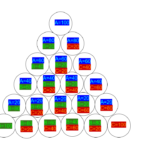
A line blend is one of the most useful glaze testing methods available. It tests how a single variable — a colorant, a flux, an opacifier, or a second glaze — changes a base glaze as you increase its amount in equal steps. The result is a series of tiles that map a range of effects in a single firing, giving you far more information than a single test tile.
When to Use a Line Blend
- Testing a new colorant in a base glaze — find the percentage that gives the color you want
- Adding a material to an existing recipe — see how increasing amounts affect the surface
- Blending two glazes — test all ratios from 100:0 to 0:100 in equal steps
- Finding the tipping point where a glaze goes from matte to satin to glossy
- Determining how much opacifier you need for full opacity
What You Need
- A base glaze — already tested and known to work at your firing temperature
- The material you’re testing
- A digital scale accurate to 0.1g
- Small containers — one per test point
- Test tiles — one per test point, labeled on the back before glazing
- A syringe or small measuring spoon for accurate small additions
Step-by-Step: Colorant Line Blend
1. Decide Your Range and Steps
Choose a starting percentage, an ending percentage, and how many steps. For most colorants a 5–7 step blend gives enough information without wasting materials. Example for iron oxide: 1%, 3%, 5%, 7%, 9%, 11% — six steps covering the full range from light amber to dark brown.
2. Weigh Equal Amounts of Base Glaze
Weigh out equal portions of your base glaze into separate containers — 100g dry weight per test point is a practical amount. Having equal base amounts makes the percentage calculations straightforward.
3. Calculate and Weigh the Colorant Addition
For each test point, calculate the colorant amount as a percentage of the base glaze weight. With 100g of base glaze, 3% colorant = 3g. Weigh accurately — a 0.5g difference at low percentages like 0.5% cobalt makes a visible difference in the fired result.
4. Mix Each Test Individually
Add the weighed colorant to the base glaze, add water to the right consistency, and mix thoroughly. Colorants need to be fully dispersed — any clumping will show as uneven color spots on the fired tile. A small immersion blender or thorough hand mixing works for small test batches.
5. Apply to Labeled Test Tiles
Apply each blend to a pre-labeled test tile. Use the same application method for all tiles — same number of coats, same thickness — so variations in the fired result come from the recipe, not the application. Dipping is the most consistent method for small test tiles.
- Tip: Apply a second coat to half of each test tile. This gives you both thin and thick application data from a single test firing.
6. Fire and Document
Fire all tiles in the same kiln load at your target cone. After firing, photograph the complete series laid out in order under consistent lighting. Record the recipe, colorant, percentages, base glaze name, cone, and kiln type. Store tiles in a labeled container or mounted on a reference board.
Two-Glaze Line Blend
A line blend can also test the ratio between two glazes — useful for finding the right balance when layering. Set up 5–7 steps from 100% Glaze A / 0% Glaze B through to 0% Glaze A / 100% Glaze B. The intermediate steps often produce the most interesting results and can become your go-to layered glaze combination.
| Step | Glaze A | Glaze B |
|---|---|---|
| 1 | 100% | 0% |
| 2 | 75% | 25% |
| 3 | 50% | 50% |
| 4 | 25% | 75% |
| 5 | 0% | 100% |
Related
See also: Triaxial Blend, Colorants and Glaze Testing, and Types of Ceramic Test Tiles.