The most useful thing you can do before building a glaze library is pick two or three reliable base glazes and run every colorant test through them consistently. This gives you a permanent, comparable reference — every result comes from the same chemistry, so you’re actually learning how colorants behave rather than chasing variables. This guide covers how to set up a systematic colorant test using proven base glazes for both cone 6 and cone 10, following a two-row tile approach that tests each colorant at a lighter and a heavier amount in a single firing.
Method 2: The Combination Matrix (36-Tile Test)
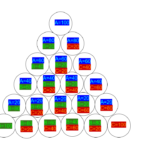
Once you know how individual colorants behave in your base glaze, the next step is understanding how they interact with each other. The combination matrix maps every pairing of nine colorants in a single 36-tile firing. Each tile shows either a single colorant at high saturation, or two colorants combined — so you can see directly how they modify each other. This is where unexpected colour discoveries happen.
How the Matrix Works
The nine colorants are arranged along both axes of a triangular grid. The diagonal tiles each show a single colorant at its full reference amount. Every other tile pairs the colorant from its row with the colorant from its column. Because the pairing is symmetrical, 36 tiles covers all 9 singles and all 36 unique combinations without duplication.
The nine colorants and their amounts:
Colorant
Single Tile (diagonal)
Combination Amount
Cobalt Carbonate
10%
1%
Chrome Oxide
10%
1%
Copper Carbonate
30%
3%
Red Iron Oxide
60%
6%
Manganese Dioxide
30%
3%
Nickel Oxide
25%
2.5%
Titanium Dioxide
60%
6%
Tin Oxide
50%
5%
Ultrox / Zircopax
100%
10%
Why the high single amounts? The diagonal tiles show each colorant at maximum intensity — a saturated reference point. The combination tiles use the lower amounts so neither colorant overwhelms the other.
Note on the math: You are making 1000g wet batches that are only 500g dry. The colorant in the master batch is 2x the percentage listed, which is then cut in half when you weigh out 100g wet batches (50g dry). To recreate any tile as a standalone glaze, use the colorant amounts shown in the individual tile cells directly.
Batching for the Combination Matrix
Parameter
Amount
Master Dry Batch
5000g base glaze without colorants
Master Water Content
4000g water (SG approximately 1.40–1.44 depending on base)
Color Batch Size
900g wet per colorant (9 batches)
Wet Blend per tile
90g wet (approximately 50g dry)
Step-by-Step
Mix a 5000g dry batch of your base glaze with 4000g water. Sieve and check specific gravity.
If your base contains Titanium or Rutile, add that batch-size-adjusted amount to the master batch before dividing. For Titanium-specific tiles, continue adding additional Titanium on top of that.
Divide the wet batch into 9 equal portions of 900g each — one per colorant.
Add the single-tile colorant amount (scaled to 500g dry) to each portion. Mix thoroughly. These nine portions are your colorant masters.
For each combination tile, weigh 90g from each of the two relevant colorant batches and combine. Mix. Apply to the tile.
For each single-colorant diagonal tile, apply 90g of the single batch directly.
Label every tile on the back. Fire at your target cone. Photograph and document the full set.
Notable Interactions to Watch For
Cobalt + Chrome: Dark complex greens and grey-greens rather than the blue of cobalt alone
Cobalt + Iron: Greys and near-blacks; the most useful combination for neutral dark glazes
Cobalt + Manganese: Shifts blue toward purple; the standard purple mix
Copper + Iron: Earthy green-browns; warm and complex
Chrome + Tin: Chrome-tin pinks if the base contains zinc — one of the most famous glaze interactions
Titanium + Iron: Warm, variegated amber surfaces with movement
Nickel + Cobalt: Subdued grey-blues; useful for muted, complex tones
Titanium + Cobalt: Mottled, textured blue with variance from the titanium
When to Use Each Method
Method 1 (Two-Amount Tile, 9 tiles): Use first when testing a new base glaze or a new colorant. Shows percentage range in isolation.
Method 2 (Combination Matrix, 36 tiles): Use once you know your base. Maps every two-colorant pairing in one firing — a permanent colour library reference.
Ian Currie Grid (35 tiles): Use for glaze chemistry development — maps the silica-alumina space for a given flux recipe. See: The Ian Currie Grid Method.
The Testing Method
The approach is straightforward. Make a 1000g batch of your base glaze without any colorant. Divide it into nine equal wet portions — one per colorant. Add the light colorant amount to each portion and dip the first test tile. Then add the additional amount to the same portion, mix, and dip a second test tile. Two tiles per colorant, both in the same firing — the first shows the lighter effect, the second shows how adding more of the same colorant changes the result.
For example: to a 100g dry portion, add 0.5g cobalt carbonate (0.5%), mix, and dip tile 1.1. Then add a further 1.5g cobalt carbonate to the same batch (now 2g total = 2%), mix, and dip tile 1.2. After firing, tile 1.1 shows soft blue and tile 1.2 shows saturated blue — directly comparable because everything else is identical.
The colorants to test, and the two amounts for each:
Colorant
Light Amount
Heavy Amount (add this to light)
Cobalt Carbonate
0.5%
+ 1.5% (total 2%)
Chrome Oxide
0.5%
+ 1.5% (total 2%)
Copper Carbonate
1%
+ 3% (total 4%)
Red Iron Oxide
3%
+ 6% (total 9%)
Manganese Dioxide
1%
+ 3% (total 4%)
Nickel Oxide
1%
+ 3% (total 4%)
Titanium Dioxide
3%
+ 6% (total 9%)
Silicon Carbide
3%
+ 6% (total 9%)
Mason Stain
5%
+ 5% (total 10%)
Tip: If your base glaze contains Titanium or Rutile, add that same amount to the master batch before dividing, then continue adding more for the Titanium-specific tiles. This keeps the base chemistry consistent across all tiles.
Step-by-Step Process
1. Mix a 1000g Dry Batch
Weigh out 1000g of your base glaze dry materials. You only need 900g to fill 9 portions but start with 1000g — mixing exactly 900g leaves you short by the time you reach the last two tiles. Mix thoroughly and sieve through 80 mesh. See: How to Mix a Glaze from Scratch.
2. Add Water — 80% of Dry Weight
Add 800g of water to the 1000g dry batch — 80% of the dry weight. Total wet batch = 1800g. Mix thoroughly and sieve. This ratio gives a workable dipping consistency for most base glazes. Keep it consistent so colorant percentages stay accurate across all nine portions.
3. Divide Into Nine Equal Wet Portions
Divide the 1800g wet batch into portions of 180g each — this gives you 10 portions worth of glaze from a 9-portion batch, leaving you with extra rather than running short. Use a syringe to measure each 180g portion accurately into nine labelled containers. The leftover glaze is your buffer — you’ll always lose a little to the sides of containers and syringe, so having extra built in keeps the process clean.
The math: 100g dry + 80g water = 180g wet per 100g dry. Scaled up: each 180g wet portion contains approximately 100g dry glaze material. All colorant percentages are calculated against this 100g dry weight — which makes the math extremely simple.
Example: 0.5% cobalt carbonate on a 180g wet portion (100g dry) = exactly 0.5g cobalt. Add, mix, dip the first tile. Then add a further 1.5g cobalt to the same portion (now 2g total = 2%), mix, and dip the second tile. Because each portion is based on 100g dry, the percentage is always the same as the gram weight — no extra calculation needed.
4. Add Light Colorant Amount and Dip First Tile
Weigh the light colorant amount based on the dry weight of each portion (each portion = 180g wet = approximately 100g dry). Because the dry portion is 100g, the percentage is identical to the gram weight — 0.5% = 0.5g, 3% = 3g, no conversion needed. Add to the container and mix thoroughly. Dip a labelled test tile — this is your first tile for that colorant. Label it with the colorant name and the light percentage.
5. Add the Additional Amount and Dip a Second Tile
Without discarding the first portion, add the extra colorant amount to the same wet batch — don’t start over. Mix thoroughly and dip a second labelled tile. This tile now has the combined total percentage. After firing, the two tiles sit next to each other showing exactly how that colorant progresses with increasing amounts in your specific base glaze.
6. Label, Fire, and Mount
Label every tile on the back before firing — base glaze name, colorant, percentages, cone, date. Fire at your target cone. After firing, arrange tiles in a row and photograph. Mount on a board or store in a labelled container. This set becomes a permanent reference. See: Types of Ceramic Test Tiles.
Cone 6 Base Glazes
Run your colorant tests through both a clear/glossy base and an opaque white base. The same colorant can look dramatically different depending on whether it’s over a transparent or an opaque ground.
A reliable, well-tested cone 6 clear glossy base that accepts colorants cleanly. Works on porcelain and stoneware. Fires clear and bright with good food safety chemistry.
Material
Amount
%
Custer Feldspar
20
20%
Wollastonite
20
20%
Frit 3134
20
20%
EPK Kaolin
20
20%
Silica (325 mesh)
20
20%
Total
100
100%
Additions
Amount
Bentonite
2
Epsom Salt
2
Specific Gravity: 1.40–1.44 for dipping. For the colorant test batches, mix the master batch to SG 1.40 then divide.
Water to dry ratio: Approximately 80–90g water per 100g dry material to reach SG 1.40–1.44. Start with 85g water per 100g dry and adjust.
White version: Add 10% Zircopax to make an opaque white liner glaze.
Note on mixing: Mix extremely thin, closer to skim milk consistency for dipping. This glaze works best thin rather than thick.
NR Ghost White (Opaque Satin White Base) — Cone 6 Oxidation
A soft satin white that accepts stains and colorants well. The opaque white ground changes how colorants read compared to the clear base — run both to see the difference. Fires smooth and opaque with a slightly silky surface.
Material
Amount
%
Custer Feldspar
34
34%
Silica (325 mesh)
24
24%
Whiting
16
16%
EPK Kaolin
12
12%
Zircopax
10
10%
Zinc Oxide
4
4%
Total
100
100%
Additions
Amount
Bentonite
2
Specific Gravity: 1.43–1.46 for dipping.
Water to dry ratio: Approximately 85–90g water per 100g dry material. The zircopax settles quickly — always stir thoroughly before use and check SG before each session.
Note: Zinc oxide interacts with some colorants — notably cobalt (can shift blue toward purple) and iron (can suppress warmth). Keep that in mind when reading results from this base versus the clear.
The most widely used cone 10 clear glaze base in studio ceramics — simple, reliable, and well documented over decades of studio use. Named for Bernard Leach, it fires clear and glossy with good chemistry across most cone 9–12 bodies.
Material
Amount
%
Potash Feldspar (Custer or G-200)
40
40%
Silica (325 mesh)
30
30%
Whiting
20
20%
EPK Kaolin
10
10%
Total
100
100%
Additions
Amount
Bentonite
2
Specific Gravity: 1.42–1.46 for dipping.
Water to dry ratio: Approximately 85–95g water per 100g dry material. Add water gradually — the high feldspar content makes this glaze thicken unpredictably if water is added all at once.
White version: Add 10% Zircopax to the base for an opaque white. The Zircopax white over cone 10 reduction iron-bearing clay bodies produces warm creamy tones from iron bleeding up through the glaze.
Atmosphere note: In reduction, iron colorants shift dramatically from their oxidation colors. Run a duplicate set of tiles in both atmospheres if you have access to a gas kiln alongside your electric.
What to Look For in the Fired Results
When you unload the tiles, evaluate each one for:
Color accuracy: Does the color match what you expected from published references? If not, note the difference — your base glaze chemistry, clay body, and firing atmosphere all modify colorant results.
Surface quality: Did the colorant change the surface? Iron at high percentages stiffens the melt. Silicon carbide creates texture. Titanium causes mottling. Note what each colorant does to the glaze surface beyond just color.
Difference between light and heavy amounts: This is the most useful data point. At what percentage does the colorant shift — from subtle to saturated, from glossy to matte, from transparent to opaque?
Difference between bases: How does the same colorant read differently over the clear base versus the white? Over cone 6 versus cone 10?
Recording Your Results
Write on the back of every tile before firing and photograph the complete set laid out in order after firing. Store tiles in a labelled container or mount them on a board. A set of colorant tests run through a consistent base glaze is one of the most valuable reference tools you can build — it takes one firing to make and you’ll use it for years.
I am a visually impaired ceramic artist. I have been making for around 8 years now. I specialize in functional colorful pottery. Mainly nerikome and other decorative processes.