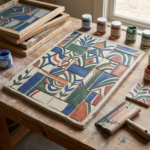
Slip transfers are a surface decoration method where you print a design in colored slip onto a flexible surface — usually newsprint or tissue paper — let it partially dry, then press it onto leather-hard pottery. The slip releases from the paper and adheres to the clay, leaving a printed impression of the design. It’s a fast way to repeat patterns and transfer imagery that would be difficult to paint freehand directly onto a curved surface.
What You Need
- Colored decorating slip — same clay body as your pottery
- Newsprint or tissue paper
- Slip trailer, brush, or screen for applying slip to paper
- Leather-hard pottery
- Rolling pin or soft rubber rib for pressing
Step-by-Step
1. Apply Slip to the Paper
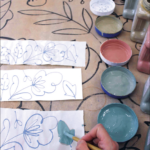
Apply colored decorating slip to newsprint or tissue paper in your desired pattern. You can brush it on freehand, use a screen or stencil for repeat patterns, or trail it with a slip trailer. Apply an even, thin coat — thick slip takes too long to reach the right transfer consistency and is harder to control on the ceramic surface.
2. Let the Slip Partially Dry
This is the critical step. Let the slip on the paper dry until it’s no longer shiny but still slightly tacky — it should feel like the surface of leather-hard clay. Too wet and it smears on transfer; too dry and it won’t release from the paper cleanly. The window is usually 10–20 minutes depending on slip thickness and humidity.
- Tip: Test the transfer on a scrap piece first. If the slip smears, wait longer. If it cracks on transfer, you’ve waited too long.
3. Press Slip-Side Down onto Leather-Hard Clay
Lay the paper slip-side down onto the leather-hard pottery surface. For flat surfaces, press firmly and evenly with a rubber rib or rolling pin. For curved surfaces, press from the center outward using your fingers, working out any air bubbles as you go.
4. Peel the Paper
Peel the paper back slowly and steadily from one corner. The slip should release from the paper and stay on the clay. If sections are lifting with the paper, press them back down gently and wait another minute before peeling.
5. Let Dry and Continue
Let the transferred slip dry on the piece before handling. Once dry it can be left as-is, carved into for a sgraffito effect, or covered with a transparent glaze.
Variations
Gelli Plate Printing
A gelli plate (a flexible gelatin printing surface) can be used instead of paper for more complex textures and layered prints. See the full guide: Making a Gelli Plate for Silkscreen Transfers.
Screen Printing Slip
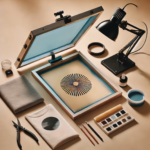
Apply slip through a silkscreen onto paper or directly onto the ceramic surface for sharp-edged repeat patterns. See: Silkscreen Stencils and Emulsion Silkscreen Stencils.
Related
See also: Slip Decoration Techniques and How to Make Decorating Slip.