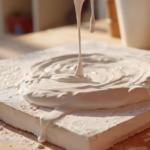
Making a ware board — or a whole stack of them — is one of the most practical things you can do for your pottery studio. The good news — you don’t need expensive materials. Here are the best options:
Best materials for DIY pottery ware boards:
- HardieBacker cement board
- ¾” birch plywood
- ½” drywall
- Particle board
Cut your boards to 12″×16″ or 12″×12″ to start. Experiment with sizes to find what works best for your workflow.
HardieBacker Cement Board (Easiest & Cheapest)
HardieBacker is the fastest and most affordable route to making a ware board. Score the surface, snap to cut, and you’re done — no special tools needed. These are especially useful for drying out smaller amounts of clay and can be sized quickly to fit your needs.
Canvas-Covered Birch Plywood Ware Boards (Most Durable)
For a more professional, long-lasting ware board, birch plywood with a canvas cover is hard to beat. Here’s the full process:
What you’ll need:
- ¾” birch plywood, cut to 12″×12″ or 12″×16″
- Duck canvas (available at clay suppliers, Michaels, or Amazon)
- Water-based polyurethane (Varathane Satin Finish works well)
- Sandpaper
- Staple gun
Steps:
- Apply 3 coats of water-based polyurethane to the board, letting each coat dry fully
- Sand smooth after all coats are dry
- Cut two pieces of duck canvas large enough to drape over the board and wrap to the underside
- Staple one side of the canvas to the board edge, stretch it taut, and staple the opposite side
- Repeat on all four sides, keeping the canvas smooth and tight
- Flip and repeat the process with the second canvas piece on the other side
The polyurethane prevents warping and makes the board water-resistant — two things that matter a lot in a working pottery studio.