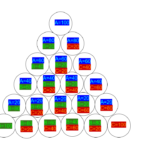
A line blend tests one variable. A triaxial tests three materials against each other. But if you want to understand how a glaze actually behaves — where it runs, where it goes matte, where it dries out and where it lands perfectly glossy — you need to vary the two ingredients that control melt and surface more than any others: silica and alumina. That is exactly what Ian Currie’s grid method does, and it does it for 35 glazes in a single firing.
Australian potter Ian Currie developed the grid (or “biaxial”) method as a systematic way to map a whole region of glaze behaviour at once. Instead of guessing and re-testing, you fire one tile of 35 related glazes and read the results like a map. This guide covers both halves of the process: making the grid tile and running the test.
What the Grid Method Actually Tests
Every glaze is a balance of three things: flux (the melters), silica (the glass former), and alumina (the stiffener that stops the glass running off the pot). In the Currie grid, the flux stays the same in all 35 glazes. Only silica and alumina change — and they change in an organized, predictable way:
Silica increases from left to right across the columns.
Alumina increases from bottom to top up the rows (added as kaolin).
Flux stays constant — the same base blend of melters in every square.
The result is a 5-column by 7-row grid of 35 numbered glazes. Tile #1 sits top-left, tile #35 bottom-right. If you have ever seen a Stull chart — the classic map of silica vs. alumina that shows the matte, glossy, underfired and crazed zones — a fired Currie grid is that chart, made real in glaze on a single tile.
The Four Corner Recipes
You do not mix all 35 glazes from scratch. The entire grid is defined by just four corner recipes. Every other square is a blend of those corners. Each recipe is given as a proportion of three parts: your fixed flux base, kaolin (alumina), and silica (quartz/flint).
Corner
Tile #
Flux base
Kaolin
Silica
Character
A (top-left)
1
60
40
0
High alumina, no added silica
B (top-right)
5
35
25
40
High alumina and high silica
C (bottom-left)
31
100
0
0
Pure flux base — the starting point
D (bottom-right)
35
50
0
50
High silica, no alumina
The four corners of a standard Currie grid. “Flux base” is your own blend of melting materials (feldspar, whiting, dolomite, frits, etc.) kept constant across the whole grid.
Notice the bottom row (#31–#35) has no kaolin at all. Those glazes will settle fast in the bucket and need constant stirring — more on that below.
Part 1: Making the Grid Tile
Currie designed a dedicated test tile so that all 35 glazes fire together, side by side, in a form that is easy to read and store. You can buy ready-made grid tiles, but making your own from your own clay body is cheap and gives you the most relevant results.
Roll a slab from the same clay body you actually use, roughly 5 × 7 inches and a sturdy 3/8″ (about 1 cm) thick so it stays flat through the firing.
Press a grid of seven rows of five shallow square wells into the surface — 35 squares in total. A small cut potato, a wooden stamp, or a grid of clay strips all work. The shallow well is important: it catches the glaze where it pools so you can see how the glaze responds to thickness.
Tilt or angle the tile slightly if you can (a small foot at the back). A tilted tile shows you at a glance which glazes run — one of the most useful things the test reveals.
Number the squares 1–35, starting top-left, and mark which edge is the top. Carve the numbers in so they survive glazing.
Dry slowly and bisque fire to your normal bisque temperature.
Part 2: Mixing the 35 Glazes
There are two ways to fill the grid. You can weigh out all 35 recipes individually — accurate, but slow and material-heavy. Or you can use the technique Currie popularized: volumetric blending, where you mix only the four corners and blend the rest by volume.
Mix the four corners
Weigh out each of the four corner glazes as a 300-gram batch using the proportions in the table above (your flux base + kaolin + silica). Slake each one down in water and sieve it through an 80-mesh screen to break up the kaolin and combine everything thoroughly.
Equalize the volumes
This is the key step that makes blending work. Add water to each corner glaze until all four occupy the same total volume (for example, top each one up to 400 mL in a measuring jug). Equal volumes mean equal blending ratios when you combine them.
Blend into 35 cups
Set out 35 small cups laid out in the same 5 × 7 grid as your tile. Using a syringe, fill each cup with a measured mix of the four corners according to its position — a cup near corner A gets mostly glaze A, a cup in the middle gets a roughly even share of all four, and so on. Each row and column is a smooth blend between the corners that bracket it.
Keep the corners stirred the entire time. Corners C and D contain no kaolin, so they settle to the bottom within seconds. If they settle while you are drawing from them, your ratios drift and the grid loses its accuracy. Stir before every draw.
Let the math do itself. Working out 35 recipes, the blend ratio for every cup, and where they all land on the Stull chart is the tedious part of this method. Our free studio companion app, Potter’s Desk, generates the full 35-glaze grid from your four corners, scales each batch to any size, and plots all 35 points live on the Stull chart — so you can see exactly which gloss, matte and crazed zones your grid will cover before you mix a thing.
Apply each glaze to its numbered square in two coats — one thin, then one thick, building to roughly 2 mm where it pools in the well. The thin-to-thick gradient within each square tells you how forgiving the glaze is to application thickness, which matters as much as the recipe itself.
Work in grid order and double-check each square against your cup before you move on.
Fire the tile to your target cone using the schedule you normally fire that cone with — the test is only meaningful at the temperature you actually use.
Set a witness cone beside the tile so you know the real heat work the grid received.
Part 4: Reading the Fired Grid
Once it is fired, the grid becomes a map you can read at a glance. Because silica and alumina change in a known direction, the surface qualities sort themselves into zones:
Bottom-left (low silica, low alumina): heavily fluxed, often running, crazed, or blistered.
Top-right (high silica and high alumina): stiff and underfired — dry, rough, or unmelted at this cone.
Upper-middle (more alumina): stable matte and satin surfaces.
Centre / lower-middle (balanced): the glossy, well-melted, durable glazes — usually where your best base lives.
Find the square you like, note its number, and you have a working recipe. From there you can run a second, tighter grid zoomed in around that square, or start a line blend adding colorants and opacifiers to your new base. One afternoon of testing replaces months of one-off guesses.
Where to Go Next
The grid method sits at the top of a family of glaze tests. If you are newer to systematic testing, start smaller and work up:
The grid method was developed and published by Ian Currie, whose work remains the definitive reference — you can read his original material at ian.currie.to.
Kevin
I am a visually impaired ceramic artist. I have been making for around 8 years now. I specialize in functional colorful pottery. Mainly nerikome and other decorative processes.