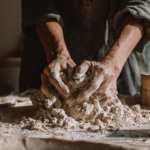
Paper clay fires the same way as standard clay — you use the same kiln, the same temperature, and the same schedule. The paper fibers burn out during firing, leaving the clay body intact with tiny channels where the fibers were. Understanding what happens during firing helps you avoid the one significant risk: firing pieces that aren’t fully dry.
What Happens to the Paper in the Kiln
Paper — cellulose fiber — begins burning off at around 200–300°C, well below the temperature range where clay starts to change structurally. By the time the kiln reaches bisque temperature (around 1000°C), the fibers have completely combusted. What remains are very fine channels or pores through the clay body where the fibers were. These channels make paper clay slightly more porous and marginally lighter than equivalent standard clay after firing, but they don’t affect mechanical strength in a meaningful way at normal studio firing temperatures.
Tip: The burnout of paper fibers produces a small amount of smoke during the early stages of firing. Fire with normal kiln ventilation. There is no more smoke than firing a standard burnout of organic materials in the clay.
The Critical Rule: Fully Dry Before Firing
Paper clay holds moisture more stubbornly than standard clay. The paper fibers absorb water and release it slowly — which is useful during building but becomes a problem in the kiln if the piece isn’t completely bone dry before loading. Residual moisture trapped in the fiber matrix turns to steam in the kiln and can cause pieces to crack or explode.
This risk is higher with paper clay than standard clay because:
The fibers hold moisture even when the clay surface feels dry to the touch
Thick sections and areas with high fiber concentration dry more slowly than the surrounding clay
Repairs and joins made late in the drying process — especially bone dry repairs — may still hold moisture in the join area even when the rest of the piece feels dry
How to Ensure Full Dryness
Allow paper clay pieces extra drying time compared to standard clay — at least 20–30% longer for equivalent thickness
For thick pieces or late repairs, leave an additional 24–48 hours beyond when the piece feels bone dry before loading
A warm spot near (not on) the kiln is a good final drying location for pieces before loading
A slow bisque schedule with a pre-heat hold at 100–120°C for 1–2 hours drives out residual moisture safely before the temperature rises into the danger zone
Bisque Firing
Bisque fire paper clay on the same schedule as your standard clay body. A slow initial ramp (50–80°C per hour) up to around 600°C is good practice for any clay but especially important for paper clay because of its moisture retention. After 600°C the pace can increase normally. The burnout of paper fibers is complete by around 600°C — after this point the firing proceeds identically to standard bisque.
Glaze Firing
Glaze fire at your standard temperature and schedule. The fired paper clay body accepts glaze normally — the slight additional porosity from fiber channels actually helps glaze adhesion. No special adjustments to your glaze recipes or firing schedule are needed.
Shrinkage
Paper clay shrinks at slightly different rates than the same clay body without paper, depending on fiber content. The difference is usually small — 1–2% — but matters if you’re making matched sets or forms that need to fit together precisely. If dimensional accuracy is critical, make shrinkage test bars from your paper clay mix and fire them at your target temperature before relying on measurements from standard clay shrinkage data. See: How to Test for Shrinkage and Absorption Rates.
Alternative Firings
Paper clay can be used in raku, pit firing, and saggar firing. The same drying rules apply — pieces must be completely dry before loading. For raku, the thermal shock resistance of paper clay is similar to standard raku clay bodies; use a grogged paper clay body rather than a smooth one for best results. The fiber burnout in alternative firings is complete at the same temperature range as in standard firing.
Food Safety
Paper clay fired to vitrification at cone 6 or above and glazed with a food-safe glaze is food safe. The fiber channels close during high-fire vitrification. At low-fire temperatures (cone 06–04), paper clay remains porous after firing — the same as standard low-fire clay — and is not food safe without a glaze that fully seals the surface.
I am a visually impaired ceramic artist. I have been making for around 8 years now. I specialize in functional colorful pottery. Mainly nerikome and other decorative processes.