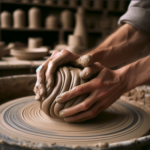
I use ram’s head wedging for smaller amounts of clay and spiral wedging for larger amounts. Ram’s head wedging is like kneading dough — except instead of making it more flexible, you are removing air and making your clay more homogeneous. If your clay is not properly wedged, you will have a really difficult time centering.
Ram’s head is the first wedging technique most potters learn — and for good reason. It is straightforward, effective, and easy to pick up. If you are newer to the studio, this is where to start. If you have been throwing for years, it is probably already muscle memory.
Either way, it is worth understanding what you are actually doing when you wedge — and what can go wrong if you skip it.
What Is Ram’s Head Wedging?
Ram’s head wedging is a push-and-rock kneading technique named for the shape the clay takes as you work it — a rounded, horned form that looks something like a ram’s head. Unlike spiral wedging, which involves a continuous rotating motion, ram’s head uses a back-and-forth rocking motion that is easier to pick up and works well for smaller amounts of clay.
The goal is the same for both techniques: remove air pockets, create a uniform texture, and align the clay particles so your piece behaves consistently from start to finish.
Why Wedging Matters
Air bubbles trapped in clay do not just cause cracking during drying — they can explode in the kiln. Even a small pocket of air expands rapidly under heat. That is a ruined piece at best, and a kiln hazard at worst.
Beyond air removal, properly wedged clay has a consistent stiffness throughout. Soft spots and hard spots make centering harder on the wheel and cause uneven walls when handbuilding. Wedge well and everything that follows is easier.
What You Need
- A wedging board (plaster, canvas-covered wood, or a clean non-stick surface)
- Your clay, cut from the bag with a wire tool
- Your hands
Start with a manageable amount — somewhere between 1 and 3 pounds is a good range for beginners. You can work larger amounts as the motion becomes natural.
How to Ram’s Head Wedge
1. Shape your starting lump
Place the clay on your wedging board and pat it into a rough oval. You want something you can grip comfortably with both hands.
2. Position your hands
Both hands sit toward the top of the ball of clay. Palms face down, fingers wrap around the clay, and your thumbs are on the inside pointing toward each other. Think of a clock — your hands form the “ears” of the ram’s head at the 11 and 1 (or 2) positions. This grip is what controls the shape as you work and keeps the clay from splaying out.
3. Push down and forward
Press down and away from you with the heels of your palms. Apply firm, even pressure — you are compressing the clay, not just pushing it across the table. Rock the clay into the board.
4. Rock back
Without fully lifting your hands, rock the clay back toward you, rotating it slightly inward as you do. This is the motion that gives the technique its rhythm — push forward, rock back, push forward, rock back.
5. Repeat
Keep the motion going — push forward, rock back. The clay should start to develop the characteristic shape — a broad base that fans out slightly on each side, with a rounded top. That is your ram’s head.
6. Check your work
After 50 to 100 repetitions, cut the clay in half with a wire tool and look at the cross-section. No air holes means you are done. If you see pockets, fold the clay back together and keep going.
Common Problems
Folding air in instead of out. This is the most common mistake. If you fold the clay over itself during the rocking motion rather than compressing it, you trap air instead of removing it. Keep the motion smooth — push and rock, do not fold.
Using too much wrist, not enough body weight. Wedging with just your arms wears you out fast and gives uneven pressure. Lean into it. Let your body weight do the work through your palms.
Working on a surface that slides. If your wedging board moves, you lose force and control. Make sure it is stable — a plaster bat on a non-slip surface is ideal.
Stopping too soon. The outside of a clay block can look smooth while the inside still has pockets. Always cut and check before you call it done.
Clay splaying out too wide. As you work, the clay develops a broad base that fans out slightly on each side — that is normal. But if it splays out too much, your hands are not in the right position. Make sure you are gripping the corners of the ram’s head with each push. Your hands control the width. Let them drift and the clay spreads out and loses its shape.
Ram’s Head vs. Spiral Wedging
Both techniques prepare clay for the same purpose. The main difference is the motion and the amount of clay they handle well.
Ram’s head is easier to learn and works well for smaller amounts — up to about 5 pounds. Spiral wedging handles larger volumes more efficiently once you have the motion down, and many potters find it does a better job aligning clay particles for wheel throwing. If you throw large, spiral wedging is worth learning. For handbuilding and smaller wheel work, ram’s head gets the job done.
Learn ram’s head first. Add spiral wedging when you are ready. You will use both.
Once Your Clay Is Wedged
Properly wedged clay is ready for whatever comes next — whether that is centering on the wheel, rolling a slab for handbuilding with an underglazed slab, or forming a pinch pot. Whatever you are making, the quality of your wedging shows up in the finished piece. It is not the glamorous part of ceramics, but it is the foundation of everything else.