Paper clay is regular clay with cellulose fiber — paper pulp — mixed into the body. That simple addition changes what clay can do in fundamental ways. You can join pieces at different moisture levels, repair bone dry greenware, build thinner walls, and work across multiple sessions without the usual moisture-matching constraints. This guide covers what paper clay is, why it works the way it does, and how to use it effectively.
A Brief History
Adding fibrous material to clay is ancient — straw in Egyptian brickmaking, cattail fuzz in Pre-Columbian pottery, papier-mâché clay in India for thousands of years. The modern ceramic paper clay movement emerged in the early 1990s through the independent work of several practitioners. Rosette Gault in Canada undertook formal research from 1990 onward and became the first to document and publish the technique widely. Brian Gartside in New Zealand and ceramic chemist Jaromir (Mike) Kusnik in Western Australia were among the other early pioneers. Graham Hay, introduced to paper clay by Kusnik at Edith Cowan University in 1992, went on to become one of its most internationally recognized practitioners and researchers — he has given over 300 paper clay workshops and talks across 14 countries, led symposiums in Hungary, the US, and Norway, and written over 30 articles for art publications in nine countries.
Why Paper Clay Works: The Science
The properties that make paper clay useful come directly from the physical structure of cellulose fibers. Understanding this makes it much easier to use the material deliberately rather than by instinct.
Capillary Action
Cellulose fibers are hollow tubes — microscopic straws running through the clay body. When wet clay is placed against dry clay, these hollow tubes act as wicks. The hollow tubes of absorbent cellulose that reach the surface of the dried out paper clay start to soak up the available water from the fresh paper clay. They perform as a network of tiny roots in the clay body, distributing moisture in a capillary action over a wide surface area.
This is why dry-to-wet joins work in paper clay but not in standard clay. In standard clay, water from wet clay floods the surface of dry clay unevenly — the outer surface rehydrates while the interior stays dry, creating stress that opens cracks as the two sections try to dry at different rates. In paper clay, the capillary network pulls water inward and distributes it through the dry section evenly, giving both pieces a chance to equalize before the join sets.
Tensile Strength in the Dry State
The key to the contemporary success with paper in clay is the removing of water-repellent lignin (part of the industrial paper manufacturing process) and mechanically separating individual cellulose fibres before or during their addition to clay. This results in a uniform dispersion of the fibre through the clay body, increasing the tensile strength of dry clay. Standard dry clay is brittle — it holds its shape only because the particles are compressed together, and any stress cracks it. Paper clay dry greenware has fiber bridging the particle boundaries, which is why it survives handling that would shatter standard bone dry clay.
Even Drying and Reduced Warping
Re-wetting paper clay is faster than re-wetting pure clay, as the paper fibres pull water more quickly into the clay body. Accelerated drying of paper clay work is possible, and results in less warping and cracking compared with drying conventional clay. The more fiber in the paper clay, the more rapid the drying with less warping and cracking. The same capillary network that distributes moisture during joining also distributes it during drying — moisture moves more evenly out of the clay body rather than drying faster at the surface than the interior.
What Happens at Firing
The cellulose fibers burn out completely during bisque firing, beginning at around 200–300°C. What remains are tiny hollow channels through the fired clay body — a microporous structure that actually helps the piece absorb thermal shocks. The fired strength is equivalent to the same clay body without fibers. The piece is slightly lighter because of the void left by the burnout.
What Paper Clay Does Differently
The capillary and tensile properties translate into practical differences at every stage:
- Wet to wet: Standard join, works as normal
- Wet to leather-hard: Capillary action distributes moisture — joins hold reliably
- Wet to bone dry: The most useful advantage — add fresh clay or a handle to a completely dry piece
- Dry to dry: Using paper clay slip as adhesive between two completely dry pieces
Benefits at a Glance
- Joins wet to dry — capillary action equalizes moisture across the join
- Stronger greenware — fiber reinforcement reduces breakage from wet to bisque
- Less cracking during drying — even moisture distribution through the body
- Repairs bone dry pieces — paper clay slip bonds where standard slip won’t
- Supports thin extensions — arms, fins, delicate forms hold through drying and handling
- Lighter fired weight — fiber burnout reduces mass
- More forgiveness in multi-session building — sections at different stages can still be joined
When to Use Paper Clay
Repairing Greenware
A crack in a leather-hard or bone dry piece doesn’t have to mean starting over. Press the crack closed, work paper clay slip into it, smooth the surface, and dry slowly. See: Paper Clay Slip for Repairs and Joins.
Adding Handles and Attachments Late
With paper clay you can add a handle to a bone dry mug. Score lightly, apply paper clay slip made with magic water, press firmly, support while drying, and fire normally. Standard clay joins to bone dry almost always fail; paper clay joins hold.
Hand-Building Complex Forms
For coiling, slab construction, and multi-session builds where sections dry at different rates, paper clay removes the need to carefully match moisture levels before every join.
Sculpture and Thin Extensions
Long thin forms — arms, necks, antennae, fins — are fragile in standard clay. Paper clay’s tensile strength supports these through drying and handling. See: Paper Clay for Sculptural Work.
Limitations
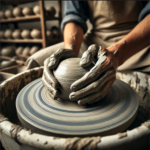
- Not suitable for wheel throwing — fibers resist centering and pulling
- Not suitable for slipcasting — fibers clog plaster mold surfaces
- Dries faster — store wrapped tightly; label clearly (it looks identical to standard clay)
- Surface texture — fiber texture becomes more visible as the clay dries; smooth at soft leather-hard for clean surfaces
Commercial vs Homemade
Paper clay is available pre-mixed from most ceramic suppliers. For repairs and joins, making your own from your studio clay body is preferable — the shrinkage matches exactly. For new construction, commercial paper clay at the correct firing temperature works well. See: How to Make Paper Clay.
Related
See also: How to Make Paper Clay, Paper Clay Slip for Repairs, Firing Paper Clay, and Paper Clay vs Regular Clay.


what wonderful gift your site is!!
from patron of willamette art center, salem oregon