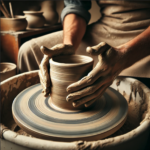
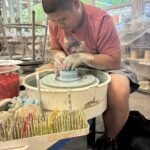
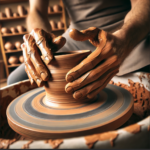
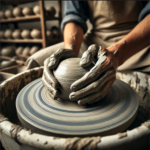
Pulling is the core motion of wheel throwing — but not all pulls are the same. Different hand positions, pressures, and directions produce different results. Understanding the main types of pulls and when to use each gives you deliberate control over your forms rather than relying on instinct alone.
1. The Knuckle Pull
The knuckle pull uses the first knuckle of your right index finger on the outside instead of the fingertip. Curl your index finger — the first knuckle is your contact point. Left hand on the inside, fingers pointing upward then inverted downward, pressing outward from inside the wall. Right hand on the outside with the thumb touching the middle and ring fingers, forming a supported brace that locks the outside hand in position while the inside hand drives the clay upward.
The knuckle covers more surface area than a fingertip, which helps move larger amounts of clay in fewer passes. The trade-off is reduced sensitivity — it’s harder to gauge wall thickness by feel. Use it for the first two to three pulls on a larger piece to build height from thick walls, then switch to pinching for thinning. On smaller forms, one to two passes is usually enough.
Key note: Both hands must move upward at exactly the same speed. Any mismatch creates uneven wall thickness.
2. The Inverted Pull
The inverted pull is used specifically to move large amounts of clay upward in the early passes on a thick-walled cylinder. The right hand is inverted on the outside — thumb and index finger closest to the wheelhead, pointing downward, gripping the wall from below. The left hand stays in its normal inside position.
Inverting the outside grip lets you apply upward lifting force from underneath the clay mass, working with the clay’s weight rather than against it. Most effective on larger forms (500g and above) where a standard lifting pass doesn’t move enough clay efficiently. Use it for the first one to two passes to establish height, then switch to knuckle or pinch pulls for thinning.
Key note: Keep the inverted hand relaxed. The power comes from the direction of the lift, not from squeezing. Gripping too hard distorts rather than lifts the clay.
3. The Pinch Pull
Place your outside thumb against the exterior wall with your four fingers on the inside. Your thumb and middle two fingers pinch the wall between them — thumb outside, fingers inside. Press gently toward each other while moving upward in a slow, controlled motion. The clay thins between the two contact points.
The pinch is the most sensitive pull and gives the clearest feedback on wall thickness. Use it for thinning passes after height is established, and again at the very end for final delicate thinning — with no water.
4. The Collaring Pull
Collaring narrows the diameter by applying inward pressure from both sides simultaneously. The clay compresses inward and rises slightly. Use it to narrow the neck of a vase or bottle, close the top of a lidded form, or bring back an opening that has flared too wide. See How to Collar the Clay for the full guide.
Key note: Collar in small increments — two to three gentle passes rather than one aggressive collar. A single large collar wrinkles the clay at the neck. If your walls are thin or uneven, keep a finger on the inside to prevent buckling at the rim.
5. The Bellying Pull
The bellying pull pushes the wall outward at a specific point to create a curve. The inside hand pushes outward while the outside hand applies only light guiding pressure. Start the push below where you want the widest point and release pressure gradually as your hand rises above it.
Key note: Belly the clay before your final thinning passes, not after. Trying to belly a very thin wall risks collapse.
6. The Rib Pull
A rib held against the outside wall while the inside hand pushes outward. The rib smooths the surface, removes fingerprint marks, and refines the wall profile — a straight rib produces a straight wall, a curved rib produces a corresponding curve. Use it for finishing, refining curved profiles, removing excess water, and compressing the surface. A straight rib used after trimming also burnishes the clay effectively.
The Three-Pull Rule and the Sponge Technique
Target three height pulls to reach the full height of the vessel. Every pull beyond three adds water and weakens the wall. Three pulls done well are far better than six done carelessly.
Once three pulls are working reliably, use the cut sponge technique to control water precisely. Take a standard yellow household sponge and cut it in half along the flat face. Saturate one half, then squeeze out about 50% of the water — damp but not dripping. Hold the sponge with the rounded edge in your palm: one corner tucks between your pinky and ring finger, the other between your index and middle finger. The flat cut edge faces the clay wall. This delivers a controlled, even amount of water exactly where needed without flooding the clay.
Hard rule: Stop adding water after your three height pulls are done. All shaping, refining, bellying, and finishing happen on dry or near-dry clay from that point. Water added during finishing passes weakens what the height pulls built.
Beginner Tips: Collar After Every Pull and Manage Outside Pressure
When starting out, collar the clay lightly after every pull. A brief, gentle inward squeeze with both hands after each lifting pass keeps the clay under control, prevents the walls from flaring unpredictably, and gives you a moment to assess the form before the next pass. It costs very little time and saves a lot of collapsed or over-flared pieces.
Unless you are making a bowl, apply slightly more pressure from the outside hand than the inside on every pull. Bowls need to open and flare — that is their shape. Everything else (mugs, vases, cylinders, bottles, lidded forms) needs to stay controlled and upright. Letting the inside hand dominate opens the clay out. Keeping the outside hand dominant keeps the form tall and vertical. If your pieces keep flaring when you don’t want them to, increase outside pressure slightly and you’ll feel the clay respond immediately.
The Pull Sequence for Most Forms
- Knuckle pull — first 1–2 pulls to build height; use on larger, thicker forms
- Inverted pull — first 1–2 passes on very large forms (500g+) to move clay upward from thick walls
- Pinch pull — main thinning passes to bring walls to working thickness
- Bellying pull — if the form needs a curve at a specific height
- Collaring — if the form needs to narrow; beginners collar after every pull
- Pinching — final delicate thinning if needed; no water
- Rib pull — refine outside profile and compress the surface
Related Posts
Wheel Throwing Essentials — How to Pull and Shape Clay — How to Collar the Clay in Wheel Throwing — How to Throw a Bowl — Throwing Off the Hump