Creating a well-crafted ceramic mug starts with proper clay preparation and centering on the wheel. This guide covers the full process — from weighing your clay to trimming and attaching a handle — plus every body shape variation, proportion guide by size, and how to match handle style to form.
Step-by-Step: Throwing a Mug
1. Weigh Out Your Clay
Start by weighing your clay to ensure consistency across all your pieces. Proper weight control helps you create uniformly sized ceramics, especially when making sets. See the proportion guide below for clay weights by mug size.
2. Wedge the Clay: Ram’s Head or Spiral
Before placing your clay on the wheel, wedge thoroughly to eliminate air bubbles. Use ram’s head or spiral wedging. If you’re unsure whether it’s fully wedged, cut it in half and check. Bubble-free clay is smooth and consistent all the way through.
3. Attach the Clay to the Wheel
Round the bottom of the ball and throw it firmly into the center of the wheel head. Alternatively, place it on center, pat down, and seal the base by pressing your fingers along the bottom edge to attach it securely.
4. Center the Clay
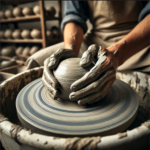
Centering is key to a symmetrical mug. With wet hands, press evenly on both sides as the wheel spins. Keep the pressure balanced and compress the clay into a smooth mound.
5. Open the Clay
Use your thumbs or fingers to open a hole in the center. For a mug, open to about 3–4 inches in diameter, keeping the sides even. Leave about 8–10mm of clay at the base before pulling.
6. Pull the Walls
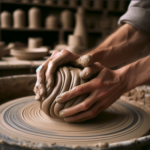
Pull the wall upward using consistent pressure, stretching the clay to the desired height. Focus on straight pulls for even wall thickness. The shape you’re aiming for determines how you direct the clay — see Body Shapes below.
7. Collar the Clay
Once at height, gently collar in at the top to control the diameter and prevent the walls from flaring outward. Repeat pulling and collaring until you reach your desired height and thickness.
8. Trim the Bottom Edge
Use a wooden knife tool to trim and smooth the bottom of the piece where it meets the bat. A slight bevel makes wiring off cleaner.
9. Level the Rim
If the walls are uneven, use a needle tool to cut the top level. Follow up with a sponge or damp fingers to smooth and compress the rim.
10. Wire Off
Position the wire tool at the base closest to you and pull through in a steady motion. Apply slight downward pressure with your thumbs to keep the wire flat against the bat.
Trimming Your Mug
Once the mug reaches leather-hard, trim the foot ring:
- Center upside down on the wheel and secure with clay coils around the rim.
- Mark the foot ring diameter — roughly one-third inset from the outer edge for most mugs.
- Trim with a loop tool, working from outside in. Listen for a hollow sound — that means the walls are thin. Stop.
- Bevel the foot edge to prevent chipping in the kiln.
For the full trimming guide including foot ring styles, see How to Trim Pottery and Cut a Foot Ring.
Mug Body Shapes
Once you can throw a consistent form, the differences between shapes come down to where you direct the clay during pulling.
Straight Cylinder
Vertical walls from base to rim. The foundational shape — every other mug builds from this. Clean and modern. Good for testing glazes.
Tapered (Wider at the Rim)
Narrows toward the base. The most common studio mug shape. Angle your inside hand slightly outward during the final pulls. A subtle flare at the rim makes it comfortable to drink from.
Belly Mug
Widest in the middle. Let the lower half push outward during the first pulls, then collar the upper portion in. Holds heat well. Organic and rounded profile.
Waisted
Narrower in the middle, wider above and below. Collar the clay in at the midpoint, then let the top flare back out. More challenging to throw consistently but very distinctive.
Flared Rim
Straight body with the top inch or two flaring outward. Apply gentle outward pressure at the very end of throwing. Compress the thinning rim carefully — it cracks easily if rushed.
Yunomi
Taller and narrower than a Western mug, slight inward curve at the rim, small or no handle. Associated with Japanese tea drinking. Trimmed with a tall narrow foot ring (kodai).
Proportion Guide by Size
These are starting points — adjust for your clay body’s shrinkage rate (typically 10–13% for cone 6 porcelain).
| Size | Finished Volume | Clay Weight | Approx. Thrown Height |
|---|---|---|---|
| Espresso / Small | 3–4 oz | 200–300g | 7–8 cm |
| Standard | 8–10 oz | 350–450g | 9–11 cm |
| Large / Latte | 12–16 oz | 500–700g | 11–13 cm |
| Oversized | 20+ oz | 700g–1kg | 13–15 cm |
- Tip: Fill finished mugs with water and measure in ml to track your actual fired volumes. After a few firings you’ll know exactly what clay weight produces what finished size for your clay body.
Handle Styles
Pulled Handle
Made by pulling clay downward from a thick coil. Tapered, organic, with natural throwing marks. The most traditional handle for wheel-thrown mugs. Works on every body shape.
Handbuilt / Slab Handle
Cut from a rolled slab. Flat, graphic, consistent thickness throughout. Works well on cylinders and modern forms. Can be faceted or textured before attachment.
Hybrid Handle
A slab handle that’s been pulled slightly — consistent thickness with a softer feel. Good middle ground between a pulled and slab handle.
Loop / Thumb Handle
A small ring sized for one or two fingers. Used on yunomi and espresso cups. Suits smaller, taller forms where a full handle would look oversized.
Extruded Handle
Made with a clay extruder for a consistent cross-section throughout. Good for production work where handle consistency across a set matters.
Matching Handle to Shape
- Straight cylinder: Pulled or slab both work. Slab reinforces the geometric feel.
- Tapered body: Pulled handle suits the organic taper naturally.
- Belly mug: A pulled handle with a generous curve echoes the rounded body. Avoid flat slab handles.
- Waisted form: A slender pulled or loop handle keeps the balance. A large handle overpowers a delicate waist.
- Yunomi: Loop handle or no handle.
Attaching the Handle
Both the mug and handle need to be at the same leather-hard stage before attaching. Score both contact surfaces in a crosshatch pattern, apply a thin layer of the same clay body slip, press firmly, and blend the edges into the wall. See the full guide: How to Attach a Handle.
Practice Makes Perfect
Many instructors recommend throwing away the first 100–500 pieces to build the muscle memory. Occasionally wire through a finished piece to check wall evenness — it’s the fastest way to see where your technique needs work.
Shop B2W Ceramics
Love handmade mugs? Browse our collection of wheel-thrown porcelain mugs — including the Small Mug, Large Mug, and Peacock Mug.