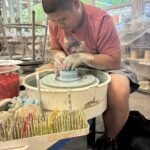
Pinching and coiling are the two most ancient handbuilding techniques — and they work beautifully together. A pinched base gives you an organic, intimate starting point, while coiling lets you build height and complexity beyond what pinching alone can achieve. The combination produces vessels with a directness and expressiveness impossible to replicate on the wheel.
What You Need
- Wedged clay — a grogged stoneware body is more forgiving for this technique than pure porcelain
- A canvas-covered or hardi-backer, concrete board work surface
- Scoring tool
- Joining slip or magic water
- A rubber rib and a metal rib
- A banding wheel or turntable (strongly recommended)
Step-by-Step: Pinch and Coil Combined
Step 1: Make a Pinched Base
Start with a ball of clay sized for your intended base — 8–12oz for a medium vessel. Pinch the ball into a bowl or cup shape using the thumb-in-and-pinch method. Work the walls to a consistent thickness of about 5–7mm. The pinched form becomes the base and lower walls of your vessel.
Pro Tip: Rotate the piece constantly as you pinch — work around the circumference rather than pinching in one spot repeatedly. This keeps the walls even and the form centered.
Step 2: Allow the Base to Firm Up
Allow the pinched base to reach soft leather-hard before adding coils. It needs to hold the weight of the coils without deforming. Set it on a bat and cover the rim loosely with plastic while the base firms — this keeps the rim workable while the lower section stiffens.
Pro Tip: Do not rush this step. A base that is too soft will sag and distort when you add the weight of coils. If your coils are sinking into the rim, the base is too wet.
Step 3: Roll Your Coils
Roll coils to a consistent diameter — 8–12mm works well for medium vessels. Roll on a canvas surface using both hands, moving from the center outward to achieve even thickness along the full length. Cut coils to a workable length — about the circumference of your vessel.
Pro Tip: Keep your working surface wet by misting the surface not your coils. Inconsistent coil diameter is the number one cause of uneven walls. Spend time rolling consistently — a thin spot in a coil becomes a thin spot in your wall. If this happense take the coil and fold it in half, twist the coil by rotating it around itself. Then try to roll out the coil again.
Step 4: Score and Apply the First Coil
Score the top edge of the pinched base thoroughly with a serrated rib or fork. Apply joining slip or magic water to the scored surface. Lay the first coil along the top edge of the base, pressing it firmly down and inward. Join the coil ends cleanly — cut both ends at a diagonal so they overlap, then blend the join. The Scoring can be omitted if the clay is still wet enough.
Step 5: Blend from the Inside First
Before doing anything on the outside, blend the coil into the wall on the inside. Use a finger or rib to press the coil clay downward into the wall below it in a smooth, short motions around the inside circumference. Inside blending is more structurally important than outside blending — this is where the join is made.
Pro Tip: Think of the blending motion as pulling the coil clay down into the wall below, not just smearing it across. A downward motion creates a stronger mechanical bond than a horizontal smear.
Step 6: Blend the Outside
Once the inside is blended, blend the outside with a rib or your fingers. You can blend completely — eliminating all coil marks for a smooth surface — or leave the coil marks visible as a textural feature of the finished piece. Both approaches are valid.
Step 7: Build Up with Additional Coils
Add the next coil only after the previous one has been fully blended and the wall has firmed enough to support the next layer. Working too wet causes the walls to slump under the weight of successive coils. Alternate between adding coils and letting the walls stiffen slightly.
Pro Tip: For tall vessels, build in stages — add 3–5 coils, then cover and let the lower section firm to soft leather-hard before continuing upward. A tall soft wall will slump under its own weight. To speed it up, you can use a torch or heat gun but be careful as it can also crack if heated, dried too fast.
Step 8: Shape as You Build
Unlike wheel throwing, handbuilding allows you to shape the form at any point by placing coils at different diameters. Place a coil at a wider diameter to expand the form outward; place a coil at a narrower diameter to bring it inward. You have complete freedom over the form at every stage of building.
Step 9: Final Refining
Once the full height is reached, do a final refining pass with a metal rib on the outside to compress the surface and define the profile. Smooth the inside with a rubber rib. Use a damp sponge to clean up the rim and any rough areas.
Pro Tip: Dry the finished piece very slowly — cover loosely with plastic and rotate it every day to ensure even drying. Uneven drying is the primary cause of cracking in handbuilt pieces. This piece is thicker than wheel or slab built pieces and may have inconsistent wall thicknesses, so dry very slowly. Make sure to let it dry for quite a while.
For more on handbuilding, see Handbuilding Essentials, Coiling Technique, and How to Make a Pinch Pot.