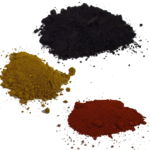
A frit is a pre-melted glass that has been quenched in water and ground back into a fine powder. In ceramic glazes, frits are used to introduce fluxes and other glaze components in a stable, consistent, and safer form than the raw materials they replace. Understanding what frits do — and when to use them instead of raw materials — is useful for anyone developing or troubleshooting glazes.
How Frits Are Made
Raw glaze materials are melted together at high temperature in a frit furnace, then the molten glass is poured into cold water. The sudden quenching shatters it into small fragments which are then ground into fine powder. This process locks the constituent oxides into a stable glass structure. The resulting frit powder is chemically similar to the raw materials it was made from but behaves very differently in a glaze — it’s stable, insoluble, and consistent batch to batch.
Why Use Frits Instead of Raw Materials
Makes Soluble Materials Safe to Use
Some valuable flux materials are soluble in water — sodium carbonate (soda ash) and potassium carbonate, for example. If you add these directly to a glaze bucket, they dissolve into the water and don’t stay evenly distributed in the glaze. When the glaze dries on bisqueware, the soluble materials migrate to the surface as the water evaporates, leaving blotchy, uneven coverage. Fritting locks these soluble materials into a glass structure that doesn’t dissolve — the frit stays suspended in the glaze evenly.
Makes Toxic Materials Safer to Handle
Lead, barium, and some other glaze materials are toxic in their raw form — the fine particles are a serious inhalation hazard. Fritting locks these materials into a glass structure that is far less bioavailable and significantly safer to handle. Lead frits were historically used in this way (though lead glazes are no longer appropriate for functional studio ware). Barium frits are still used where barium’s flux properties are wanted without the hazard of raw barium carbonate dust.
Consistency
Raw natural materials like Gerstley Borate and colemanite are variable — the mineral composition can shift between batches, causing glaze results to change unpredictably. Frits are manufactured to tight tolerances and are chemically consistent batch to batch. Replacing a variable raw material with a frit equivalent is one of the most reliable ways to stabilise a glaze recipe.
Improves Melt at Lower Temperatures
Because frits have already been through one melting cycle, they soften and begin contributing to the glaze melt at lower temperatures than equivalent raw materials. This makes frits particularly valuable in low-fire and mid-fire glazes where the firing temperature isn’t high enough to fully react all raw materials.
Common Frits Used in Studio Ceramics
Frit numbers are regional. A recipe that calls for “Frit 3134” was almost certainly written in North America, and the bag on a shelf in Stoke, Limoges, Bengaluru or Melbourne is a different glass with a different analysis. The charts below are grouped by where you buy, with the published oxide analysis for each frit where the maker publishes one. Percentages are weight percent and total about 100, since frits carry no LOI.
United States and Canada — the Ferro (now Vibrantz) 3xxx line
| Frit | Analysis (weight %) | What it’s for, and equivalents |
|---|---|---|
| Ferro Frit 3134 | SiO₂ 45.6 · B₂O₃ 22.8 · CaO 19.5 · Na₂O 10.1 · Al₂O₃ 2.0 | The generic “borax frit.” A hard-working low-temperature melter with almost no alumina, so it boosts the melt without stiffening it — the reason it suits reactive, rutile and crystalline glazes, and why you can carry the alumina in clay instead. Its soda gives it a fairly high thermal expansion, so it is not the frit to reach for if a glaze crazes. Equivalents: Fusion F-12, Pemco P-54, UK Standard Borax Frit, Australian Frit 4108 / 4144. |
| Ferro Frit 3124 | SiO₂ 54.9 · B₂O₃ 13.7 · CaO 14.3 · Al₂O₃ 10.0 · Na₂O 6.4 · K₂O 0.7 | The most broadly useful of the common frits, and the one most often missing from beginner frit lists. Its chemistry is close to a finished glaze already: add 10–15% kaolin and you have a glossy transparent at cone 04, or use it at 20–40% in a stoneware glaze. The built-in alumina makes it the steadier choice where 3134 would run. Equivalents: Fusion F-19, Pemco P-311, Hommel 90, Australian Frit 4124. |
| Ferro Frit 3195 | SiO₂ 48.4 · B₂O₃ 22.6 · Al₂O₃ 12.0 · CaO 11.4 · Na₂O 5.7 | Like 3124 but with far more boron and more alumina, so it melts earlier and sets up a stabler, slightly less glossy glass. Also a base glaze in its own right with 10–15% kaolin, and a good general boron source up into cone 6. The high alumina will shut down rutile and crystal effects, which is exactly when you want 3134 instead. Equivalent: Fusion F-2. |
| Ferro Frit 3110 | SiO₂ 69.6 · Na₂O 15.4 · CaO 6.3 · Al₂O₃ 3.7 · B₂O₃ 2.6 · K₂O 2.3 | Essentially a man-made low-alumina super feldspar, and barely a boron frit at all. Think of it as an insoluble way to get sodium in. The payoff is bright alkaline colour — it is what gives copper those turquoise blues — and the cost is a very high thermal expansion, so it crazes readily. Useful in small amounts to cure shivering, and in slips and engobes. Equivalents: Fusion F-75, Australian Frit 4110. |
| Ferro Frit 3249 | SiO₂ 42.1 · B₂O₃ 28.9 · Al₂O₃ 13.3 · MgO 12.2 · CaO 3.5 | The craze fixer. Magnesium is the lowest-expansion flux there is, and this frit delivers it already melted, which talc and dolomite cannot do at low and middle temperatures. Swapping some of the 3134 in a crazing glaze for 3249 pulls the expansion down hard — so hard it can shiver on a body that was never crazing to begin with. Expensive, and its heavy boron can overshoot if you use it to source all the magnesium. Equivalents: Fusion F-69, Pemco P-1409. |
- Note: these are made by Ferro (now trading as Vibrantz) and are what most North American recipes assume. Fusion and Pemco make close equivalents, listed above. Digitalfire is not a frit maker — it is the reference library where most of these published analyses live.
Europe and the UK
European suppliers mostly sell frits by description — standard borax, high alkaline, calcium borate, low expansion — rather than by a number. Where they do borrow the Ferro numbers, the glass is their own: Ceradel’s 3134 carries no alumina at all against Ferro’s 2%, so a recipe calculated on the North American figures will be slightly off.
| Frit | Analysis (weight %) | What it’s for |
|---|---|---|
| Standard Borax Frit (Potterycrafts P2957, UK) | SiO₂ 62.2 · B₂O₃ 14.7 · Al₂O₃ 9.4 · CaO 7.3 · Na₂O 3.6 · K₂O 2.7 | The everyday leadless earthenware frit, and what a UK recipe means by “borax frit.” Note it is not a like-for-like 3134 — it carries real alumina and far less boron. |
| Calcium Borate Frit (Potterycrafts P2954, UK; Potclays 2268) | B₂O₃ 50.4 · CaO 27.1 · SiO₂ 17.7 · Al₂O₃ 4.8 | The UK’s Gerstley Borate and colemanite stand-in. More than twice the boron of 3134 and almost no silica, so never swap it in by weight — recalculate. |
| Potterycrafts P3195 (UK) | SiO₂ 47.4 · B₂O₃ 23.0 · Al₂O₃ 12.4 · CaO 11.2 · Na₂O 6.0 | A genuinely close match to Ferro 3195, so US recipes calling for it translate directly. |
| Low Expansion Frit (Bath Potters, UK) | SiO₂ 63.6 · B₂O₃ 17.8 · Al₂O₃ 8.2 · CaO 3.6 · ZnO 3.3 · MgO 2.4 · Li₂O 0.1 | The UK answer to 3249 for crazing, using zinc, magnesium and a trace of lithium. Goes milky in large additions. |
| High Alkaline Frit (Potterycrafts P2962, UK) | No full analysis published | Soft, fluid and very high expansion — the raku and crackle frit, and the UK’s rough counterpart to 3110. Blend with standard borax frit to tune crackle size. |
| Ceradel Fritte 3134 (France) | SiO₂ 47 · B₂O₃ 23 · CaO 20 · Na₂O 10 | Same role as the Ferro frit, but with no alumina at all. |
| Ceradel Fritte 3195 (France) | SiO₂ 48.5 · B₂O₃ 22.5 · Al₂O₃ 12 · CaO 11 · Na₂O 6 | Within a fraction of Ferro 3195 — the safest straight swap in the French range. |
| Ceradel Fritte 3110 (France) | SiO₂ 69 · Na₂O 15.5 · CaO 6.5 · Al₂O₃ 4 · K₂O 2.5 · B₂O₃ 2.5 | High-soda alkaline frit, as 3110. |
Australia and New Zealand
Ferro runs a separate line for the Australian market under 4xxx codes. They are cousins of the 3xxx frits, not copies, so working from a local bag with North American numbers will give slightly wrong chemistry.
| Frit | Analysis (weight %) | Closest US frit |
|---|---|---|
| Ferro Frit 4110 | SiO₂ 69.2 · Na₂O 15.3 · CaO 6.1 · Al₂O₃ 4.2 · B₂O₃ 2.7 · K₂O 2.5 | 3110 |
| Ferro Frit 4124 | SiO₂ 57.6 · B₂O₃ 14.4 · CaO 14.2 · Na₂O 6.6 · Al₂O₃ 6.0 · K₂O 1.3 | 3124 |
| Ferro Frit 4108 | SiO₂ 52.2 · B₂O₃ 19.3 · CaO 16.7 · Na₂O 8.6 · Al₂O₃ 3.1 | 3134 family |
| Ferro Frit 4144 | SiO₂ 46.5 · B₂O₃ 23.1 · CaO 20.1 · Na₂O 10.3 | 3134, alumina-free |
India
India has a large frit industry, but almost all of it serves the tile trade, and the studio-facing frits are sold by purpose rather than by analysis. Artha Pottery’s line, stocked by Bhoomi, publishes no oxide figures at all, so the chart below is honest about that rather than guessing. Bhoomi also import Ferro 3110 and 3195 through Laguna, and for those the US chart above applies directly.
| Frit | Analysis | What the supplier says it’s for |
|---|---|---|
| Artha Frit 1005 Alkaline | Not published | Melts from about 750°C; lustre, raku and crystalline work. |
| Artha Frit 1006 High Alkaline | Not published | A special-purpose high-soda frit — the local counterpart to 3110. |
| Artha Frit 1007 Transparent | Not published | Crackle and raku glazes. |
| Artha Frit 1003 / 7003 / 7008 | Not published | General studio frits, sold without a stated role. |
| Artha Frit 1009 Lead Based | Not published | A lead frit — not for food surfaces without leach testing, and handle the dry powder with full respiratory protection. |
Indian frit houses such as Ceramique Industries (Kolkata) do make transparent, opaque, matt and lead frits in alkaline, alkali-borosilicate, borax and calcium-borosilicate types, but sell into industry by the 25 kg bag and publish type names rather than analyses. If you buy locally, ask for the technical data sheet — it exists, it just isn’t on the web.
Japan and the rest of Asia
This is the thinnest chart of the lot, and not for want of frits. In Japan a frit is a フリット, known historically as 白玉 (shiratama), and both leaded and lead-free types are made. But the makers supply the tableware and tile industries rather than studio potters, and they publish working temperature ranges and intended uses rather than oxide analyses. Studio recipes there tend to be written around feldspar, ash and limestone instead, with frits reserved for low-temperature work below about 1200°C. If you are working in the region, the practical route is to ask your supplier for the data sheet for the specific code you are buying, and treat any US frit number in a recipe as a chemistry target to match rather than a product to find on the shelf.
Choosing Between Frits
Once you have the analyses side by side, most of the choosing comes down to four questions.
- Do I want the frit to be most of the glaze, or just the melter? Frits carrying 10–12% alumina (3124, 3195, P3195) are close to finished glazes — add kaolin and go. Frits with little or no alumina (3134, Ceradel 3134, 4144) are boron boosters meant to sit inside a larger recipe.
- Is the glaze crazing or shivering? Crazing means the glaze expansion is too high: move toward magnesium and away from soda, so 3249 or a low-expansion frit. Shivering means it is too low: a little 3110 or high alkaline frit brings it back up.
- Do I need the melt to stay mobile? Alumina stiffens the melt. That is good for stability and bad for rutile blues, crystals and anything that needs to move — which is why 3134 works for those and 3195 kills them.
- What colour am I chasing? High-soda alkaline frits give copper its turquoise. Calcium-heavy boron frits give safer, steadier glossy clears.
In every case, swapping one frit for another is a chemistry change, not a weight change. Recalculate the recipe and fire a test tile before you commit a bucket.
When to Use a Frit
Replacing Gerstley Borate
Gerstley Borate is a naturally mined boron material that has been widely used in studio glazes for decades. It’s variable, prone to causing crawling at high percentages, and supplies have become less reliable. Ferro Frit 3134 or Pemco P-54 are the most common direct substitutes — they supply similar B₂O₃ and CaO in a more consistent form. Substituting isn’t always direct by weight since frit chemistry differs slightly from Gerstley Borate — always recalculate using glaze software. See: Glaze Making Resources.
Low Fire Glaze Bases
Most commercially available low-fire glazes use frits as their primary flux. At cone 06–04, raw feldspars and carbonates simply don’t melt adequately. Frits provide pre-reacted flux that melts at these lower temperatures reliably. If you’re developing your own low-fire glaze base, starting with a boron frit like Ferro 3195 or 3134 as 40–60% of the recipe is a common approach.
Stabilising a Variable Recipe
If a glaze gives inconsistent results batch to batch, check whether it contains high percentages of variable natural materials. Replacing them with frit equivalents often stabilises the recipe significantly.
Frits and Glaze Chemistry
When normalising a recipe to its Unity Molecular Formula, frits are treated like any other material — their oxide analysis is used to calculate their contribution to the glaze chemistry. All major ceramic suppliers publish the oxide analysis for each frit they sell. Digitalfire.com has analyses for most commonly available frits. See: How to Normalize a Glaze Recipe and What Glaze Materials Contain.
Related
See also: Glaze Chemistry Basics, Chemical Formulas for Glaze Making, and Glaze Making for Beginners.